
Report: IT infrastructure modernization for a medium-sized trading company
A medium-sized trading company with two locations and over 25 employees was facing growing pressure due to its outdated IT infrastructure. The systems were getting old—some had been in use for over 11 years—and were increasingly causing problems in day-to-day business. The eight existing virtual machines ran on two physical servers, which were causing more and more frequent disruptions. Several unplanned outages per quarter had already impacted operations, and a terminal server failure would have resulted in immediate revenue losses.
In addition, PROTOS identified a high level of effort in daily administration:
- The internal IT manager spent around 40% of his working time on reactive troubleshooting.
- Due to a lack of automation, 8–10 hours of manual tasks had to be completed each week.
- The lack of location synchronization regularly led to duplicate data sets, which had to be corrected manually.
The security situation was also critical. The existing infrastructure ran unsupported operating systems without security updates, there was no multi-factor authentication, security-related events were hardly logged, and there was no central overview of devices and access. Added to this was an outdated backup strategy that would have resulted in expensive recovery processes in the event of damage. The combination of operational burdens, security risks, and increasing complexity made it clear that a fundamental modernization was inevitable.
Strategic realignment of the IT infrastructure
To effectively address these challenges, the company decided, together with PROTOS, to completely realign its IT infrastructure. The goal was not only to replace the existing infrastructure, but to completely rethink it: moving away from rigid on-premise servers to a scalable, secure, and future-proof cloud architecture based on Microsoft Azure. The aim was to transform IT from a risk factor into a real growth driver.
The focus was on three key areas:
- Replacement of the old server landscape and transition to modern Azure services for all core functions.
- Standardized security, backup, and recovery processes to permanently prevent business-critical failures.
- Introduction of centrally controlled administration, clear access structures, and uniform compliance guidelines.
This realignment laid the foundation for an infrastructure that not only reduces operational pressure, but also offers the company long-term stability, transparency, and security.
Technical implementation by PROTOS as a managed service partner
PROTOS took over the entire implementation and subsequent managed service operation. The migration took place with virtually no downtime—a crucial factor for the retail company, which relies on continuous availability on a daily basis. All user accounts, data, and processes were transferred to a uniform Azure architecture, including Entra ID, Exchange Online, SharePoint, Azure SQL, and Azure Virtual Desktop.
Architecture diagram for IT operations and IT security at the customer’s site:
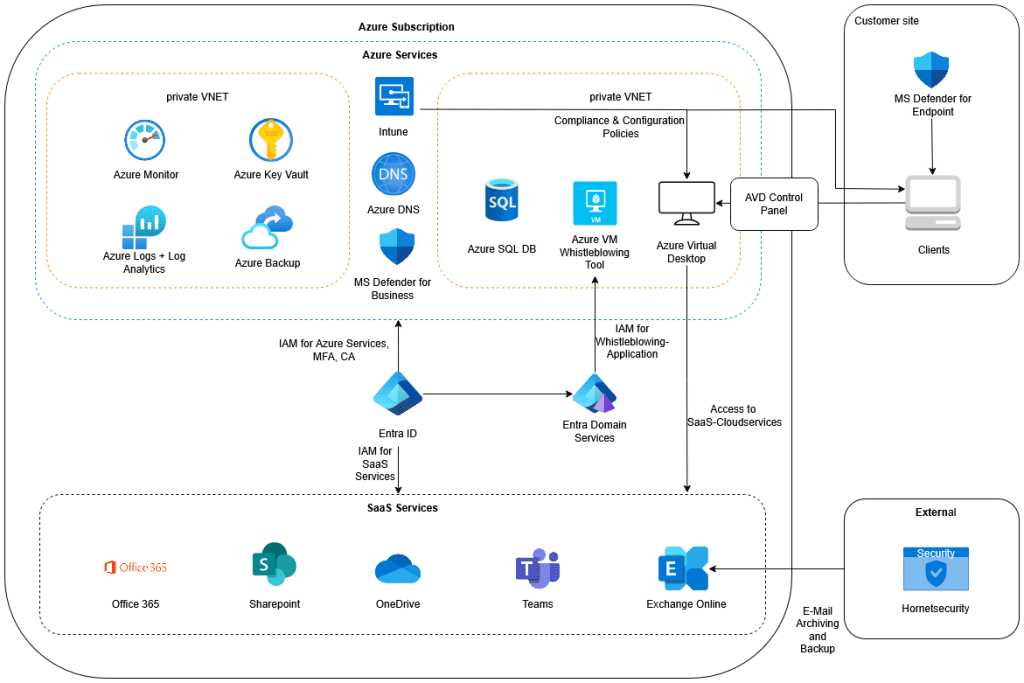
At the same time, the entire security infrastructure was revamped: MFA was introduced across the board, logging and monitoring were modernized, phishing and security training courses were conducted, and emergency procedures were documented. The 8–10 hours of manual administration work per week that had previously been necessary were largely eliminated.
A dedicated operations team took over the service with extended support hours. Critical incidents are prioritized, reducing the average response time by over 50%. In addition, the company was provided with modern endpoint management via Microsoft Intune, including automated policies, compliance checks, and device monitoring.
Further reports from our Managed Services Team
Increased efficiency and cost control during ongoing operations
The new cloud infrastructure had an immediate impact during operation. Systems ran more stably, support became faster, and security improved significantly. At the same time, cost transparency was created, opening up new management options for the company’s management.
- Availability: System availability increased from approximately 95% to over 99%, and unplanned downtime decreased by more than 70%.
- Effort: Administration times were reduced significantly as many manual tasks were automated. The internal IT manager was able to concentrate on value-adding tasks again.
- Costs & security: Clear license overviews, the elimination of outdated tools, and a modern security and backup concept ensure predictable IT costs and a significantly higher level of security.
Regular reports on availability, security, and resource utilization now provide management with a level of transparency that was previously impossible.
Digital scalability as a growth driver
Just a few months after the successful project, the company decided to integrate a third location following an acquisition. The new infrastructure made this a smooth process: users could be integrated within a few hours, security policies were automatically transferred, and cloud services could be used immediately across all locations. The rollout of MFA and access permissions was also implemented centrally and without additional effort.
This made it clear that IT was no longer a bottleneck, but a real scaling factor. The standardized cloud structure supports the company’s growth efficiently and securely – supported by a managed services model that keeps availability, security, and costs under control at all times.

„Companies in the retail sector need reliable IT. However, modernization can initially appear costly and risky, especially during operations. We resolved this bottleneck quickly and securely with the customer“, Jan Reimers, Head of Managed Services at PROTOS.

Get an overview of our managed services offerings on our focus page.
